YouTube MOD Ads Still Showing? 2026 Fixes & Reasons
You installed a MOD to escape ads—so why are they still popping up? That moment of confusion isn’t a bug; it’s a signal that something deeper is happening behind the scenes.
This article breaks down why Ads Still Appear in some YouTube MOD APK Versions and what that really means for users who expect an uninterrupted viewing experience. If you’ve noticed YouTube MOD APK ads creeping back in, you’re not alone—and it’s not always because the MOD “failed.”
The real frustration lies in wasted time, broken trust, and the feeling that every update brings a new workaround instead of a solution. From evolving Google algorithms to server-side ad delivery, YouTube’s ecosystem has changed in ways many MOD developers can’t fully control.
Drawing on how modern search engines, app architectures, and content platforms now operate, this guide connects the dots between user intent, app behavior, and ad enforcement tactics.
By the end, you’ll understand why YouTube MOD APK shows ads, what factors trigger them, and what expectations are realistic going forward—before you decide your next move. The answer isn’t as simple as “use a better MOD,” and that’s exactly why you should keep reading.
The Ad-Blocking Paradox: Expectations vs. Real-World Performance
Most MOD APKs claim to block ads completely.
It is believed by many users that these apps work just like YouTube Premium.
In most cases, ads are blocked successfully.
However, the block is not always consistent.
Some versions stop mid-roll ads only.
Others block video ads but fail to stop community posts or banners.
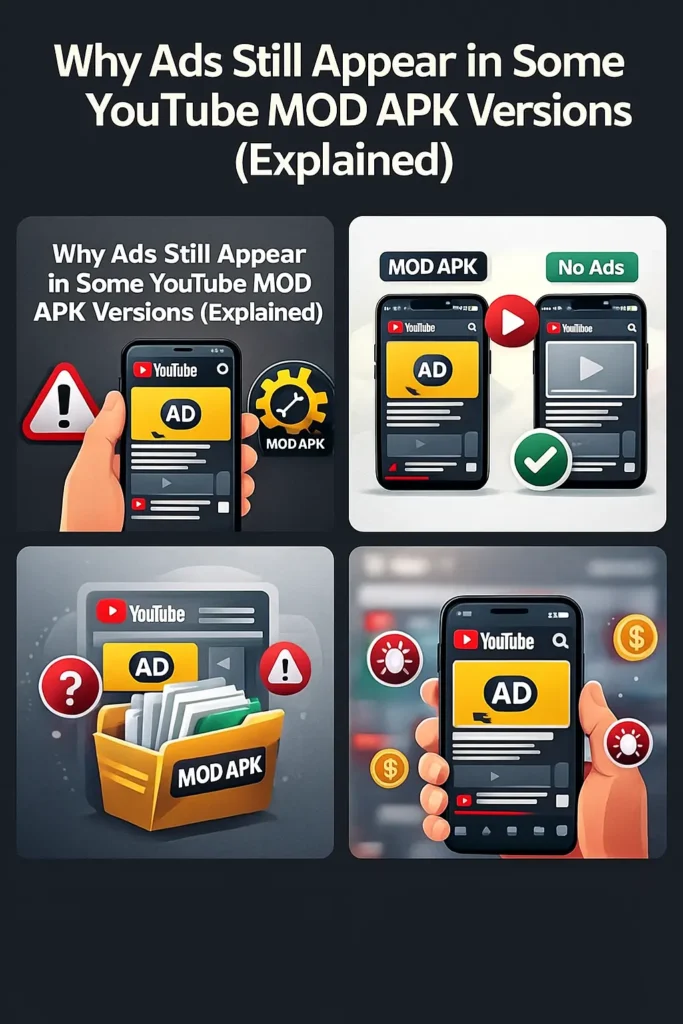
So, the promise of 100% ad-free sometimes becomes 90% ad-free.
Mechanism of Action: How Google Injects Ads into the Data Stream
It is said that YouTube uses a complex ad delivery system.
The ads are not just simple files.
They are controlled by:
- Google’s ad servers
- User data
- AI-based placement
- Dynamic ad injection
The platform changes ad rules often.
This constant change makes blocking harder for modified apps.
Official apps follow this system perfectly.
But MOD versions try to bypass it.
It is said that bypassing updates is not always perfect.
Failure Analysis: Why Your Ad-Filter Protocol is Failing
There are several reasons behind this.
The most common reasons include:
- Outdated patches
- Wrong installation build
- Server-based ads
- Authentication conflicts
- Unsupported regions
When even one part breaks, the ad blocking reduces.
Server-Side Injection: The Ultimate Barrier to Traditional Ad-Blocking
This is the most important factor.
Some ads are handled locally inside the app.
These can be blocked using patches.
But server-side ads behave differently.
They come directly from YouTube’s servers.
Because of this, the app patch cannot always block them.
These ads are dynamic and change format constantly.
So when YouTube updates how ads are injected, MODs may fail.
Version Mismatch: The Impact of Deprecated Patch Definitions
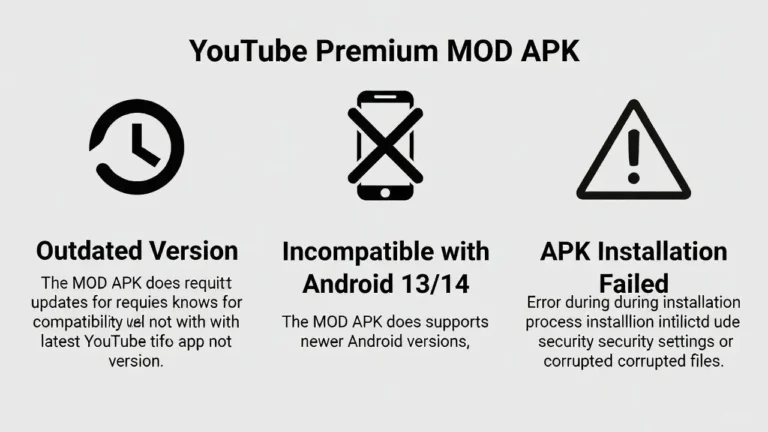
It is said that every time YouTube updates its app, the internal structure changes.
If the latest YouTube update is not matched by the MOD APK version, ad removal becomes unstable.
For example:
- A MOD from early 2024 may not block ads in late 2025.
- A patch designed for version v18.20.39 may not work for v19.30.51.
That version mismatch creates gaps.
Ads slip through those gaps.
The MicroG Factor: Interface Errors and Ad-Injection Leaks
Most YouTube MOD versions require MicroG for login and sync.
But MicroG updates more slowly than official Google frameworks.
If MicroG is outdated, some MOD features do not activate correctly.
That means:
- Patch instructions may fail
- Ad-block logic may not load
- Playback rules may not apply
Sometimes updating MicroG fixes everything.
Other times, a fresh install is needed.
Structural Integrity: Comparing High-Tier vs. Low-Tier MOD Builds
Different developers create different patches.
So the results are not identical.
There are:
- Lite builds
- Extended builds
- Experimental builds
- Forked builds
Each build focuses on a different purpose.
For example:
- Some prioritize battery performance.
- Some improve playback quality.
- Some remove ads only from certain sections.
If someone installs a lightweight build, background ads may still show.
So choosing the right build matters.
Local Interference: System-Level Blocks and Battery Optimization Effects
It is said that sometimes the issue is not the MOD itself.
The issue may be caused by the device storage, cache, or system frameworks.
Such as:
- Corrupted cache
- Residual old APK files
- Conflicting extensions or modules
They said that partial ad delivery was sometimes triggered by those conflicts.
A clean installation often helps.
Geo-Dynamic Advertising: How Location Affects Ad Delivery
Some regions receive more ads than others.
YouTube follows regional ad policies.
So if a patch is designed around a different market, it may not block ads effectively.
For example:
- The U.S. and India have heavy dynamic ads.
- Some European regions use GDPR-friendly formats.
A MOD may block European formats but fail in high-ad markets.
Remediation Steps: How to Restore an Ad-Free Environment
There are a few simple steps to improve performance.
1. Update to the Latest Version
They instructed to always use the newest release.
Patch efficiency is almost always lost by older versions.
2. Install a Compatible MicroG Version
They advised to ensure that the MicroG version matched the MOD version.
Version mismatches cause instability.
3. Clear Cache and App Data
A clean cache resets ad behavior patterns.
4. Enable All Patch Options
Features like the following are allowed to be toggled by some MODs.
- SponsorBlock
- Ad-Skip
- Hide banners
They said that activating the right toggles improved results.
5. Use a Trusted Build
Avoid unknown APK sources.
Only verified builds maintain stability.
Decision Matrix: Utility vs. Annoyance in the 2026 MOD Landscape
It depends on expectations.
If someone wants a perfect ad-free platform, the official YouTube Premium subscription remains the most stable option.
But if mostly ad-free streaming is found to be satisfactory, then a MOD APK may still be felt to be worth using.
Most users accept a small compromise since the benefits remain:
- Background play
- Download support
- SponsorBlock
- Custom themes
- They mentioned “They mentioned that the app included premium-like features.premium-like features.
So the choice depends on personal preference.
Conclusion: The Ongoing Evolution of Ad-Blocking Technology
At this point, the confusion around YouTube MOD APK ads should be fully cleared. Ads still appear, not because the mod “failed,” but because of server-side ad delivery, outdated patches, or intentional limitations built into certain versions. Understanding why YouTube MOD APK shows ads helps set realistic expectations and avoids chasing quick fixes that don’t actually work.
The bigger takeaway is simple: YouTube’s ad ecosystem is far more advanced than most modified apps can fully bypass. With that clarity, you can make smarter decisions instead of relying on myths or misleading claims.
If this explanation helped, keep exploring related guides to deepen your understanding and stay one step ahead. Knowledge always beats guesswork.